About the mandir
Shri Harsiddhi Mata Mandir stands beside Rudra Sagar in Ujjain, a short walk from the Mahakaleshwar Jyotirlinga. Tradition counts it among the Shaktipeeths, the place where the elbow of Goddess Sati is believed to have fallen, and remembers the goddess as the family deity of King Vikramaditya. The temple is best known for its two tall deep-stambhs, stone lamp towers that are set alight with hundreds of oil lamps at the evening aarti.
History of the temple
Harsiddhi is counted among the oldest sacred places of Ujjain. Popular tradition holds that the shrine was first raised by King Vikramaditya, the legendary ruler of the city, and for that reason many devotees speak of it as roughly two thousand years old. That age is a matter of belief rather than of record. Descriptions of old Ujjain place the goddess on the western bank of Rudra Sagar, a lake once covered in lotuses, with Mahakaleshwar on the eastern bank. The building seen today is not ancient: the Ujjain district administration and other accounts state that the temple was reconstructed during the Maratha period, generally placed in the eighteenth century, when the Mahakaleshwar temple was also rebuilt. Some writers trace an earlier structure to the Paramara era, but this is not well documented. The old stepwell in the compound, crowned by a carved pillar, is the most visible survivor of the earlier temple.
The Shaktipeeth legend
The sanctity of Harsiddhi rests on the story of Sati. According to the Puranas, Sati gave up her life in the sacrificial fire of her father Daksha after he insulted her husband, Lord Shiva. Grief-stricken, Shiva lifted her body and wandered the worlds in a fierce dance. To calm him, Lord Vishnu is said to have divided the body with his Sudarshan Chakra, and every spot where a part fell became a Shaktipeeth, a seat of the goddess. Tradition, citing the Shiva Purana, holds that Sati's elbow fell at this place in Ujjain. Lists of the Shaktipeeths number them as 51 or 52, and they do not all agree on the details for Ujjain. Here the goddess is also remembered by the name Mangal Chandika. For devotees, a visit to Harsiddhi completes the pilgrimage of Ujjain: Shiva is worshipped at Mahakal and Shakti here, only a few hundred metres apart.
How the goddess came to be called Harsiddhi
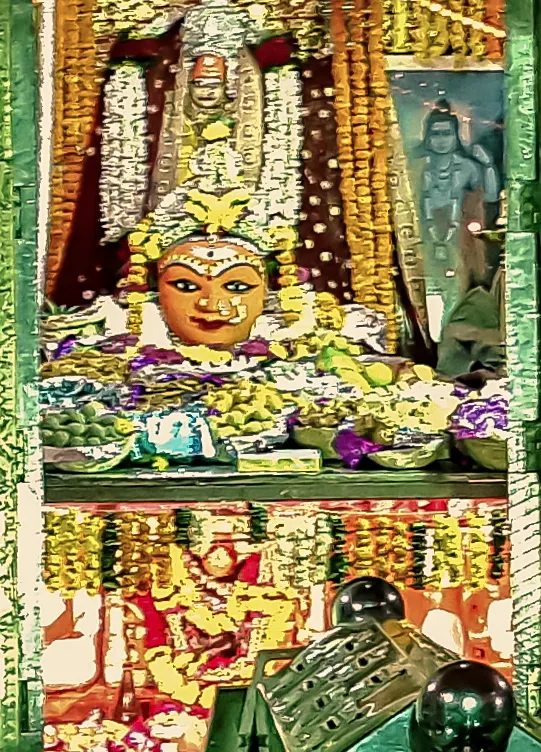
The Skanda Purana tells the story behind the name in its Avanti Khanda, the section that describes the sacred geography of Ujjain. Two powerful demons, Chanda and Prachanda, had overrun heaven and then forced their way towards Mount Kailash, attacking Shiva's attendants. Shiva called upon the goddess Chandi, who appeared and struck the two demons down. Pleased, Shiva declared that she would be known in the world as Harasiddhi, because she had brought siddhi, success, to Hara, which is a name of Shiva. The district administration's account of the temple gives the same legend. The Purana places this goddess in Mahakalavana, the ancient forest of Mahakal that is today's Ujjain, and says that those who remember and worship her are freed from fear of enemies and from want. The ninth day of Navratri, Mahanavami, is singled out in the text as especially sacred to her.
The goddess of King Vikramaditya
In the lore of Ujjain, Harsiddhi is inseparable from Vikramaditya, the king after whom the Vikram Samvat calendar is named. She is described as his kuldevi, the guardian goddess of his line, and he is said to have worshipped her daily. One widely told legend links this temple with the Harsiddhi shrine on the Gujarat coast near Miyani, close to Porbandar: the king travelled there, won the goddess's blessing and asked her to come and dwell in his capital so that he could worship her every day. Another legend says that Vikramaditya offered his own head at her feet eleven times, and each time the goddess restored him to life. These stories belong to folk tradition, not to dated history, but they explain why the temple holds a special place for the people of Malwa and why many families regard Harsiddhi as their own kuldevi.
Architecture and the sanctum
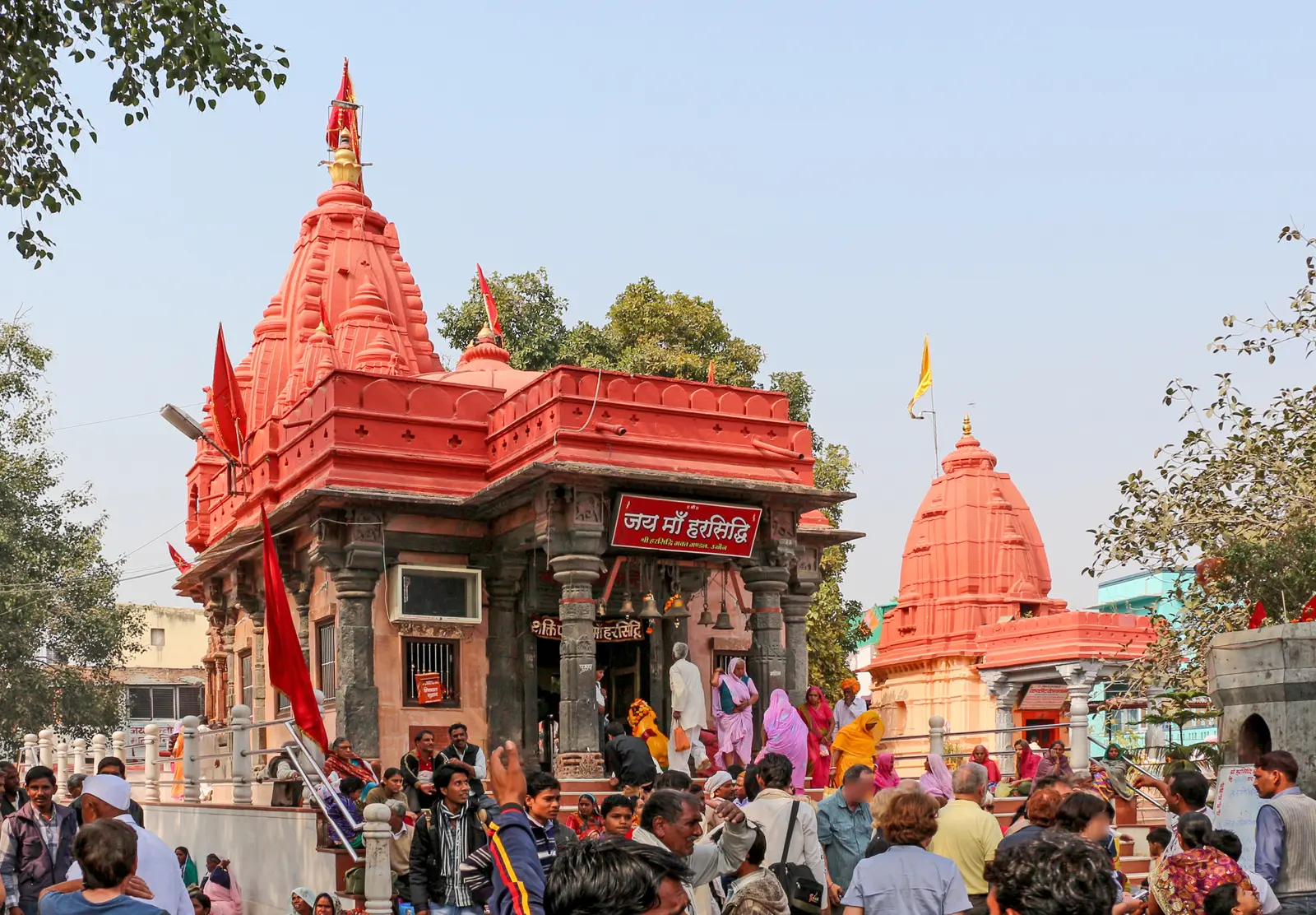
The temple stands inside a walled courtyard with gateways on all four sides; the main entrance faces east. The shrine itself is modest in size, built in the Maratha manner with a red-painted spire in the north Indian style and a pillared hall in front where devotees ring the bells before darshan. Inside the sanctum, the image identified as Annapurna, coloured deep vermilion, is seated between Mahalakshmi and Mahasaraswati; many accounts treat this central vermilion-covered image as Harsiddhi herself. A Sri Yantra, the geometric emblem of Shakti, is also enshrined in the temple and receives offerings of sindoor. Some descriptions mention a painted ceiling showing the Shaktipeeths. Within the compound are smaller shrines, among them Karkoteshwar Mahadev, and an old stepwell with an ornamental pillar rising from it. Sources report an inscription with the year 1447 on this pillar, though they differ on which calendar era is meant.
The deep-stambhs: two towers of light
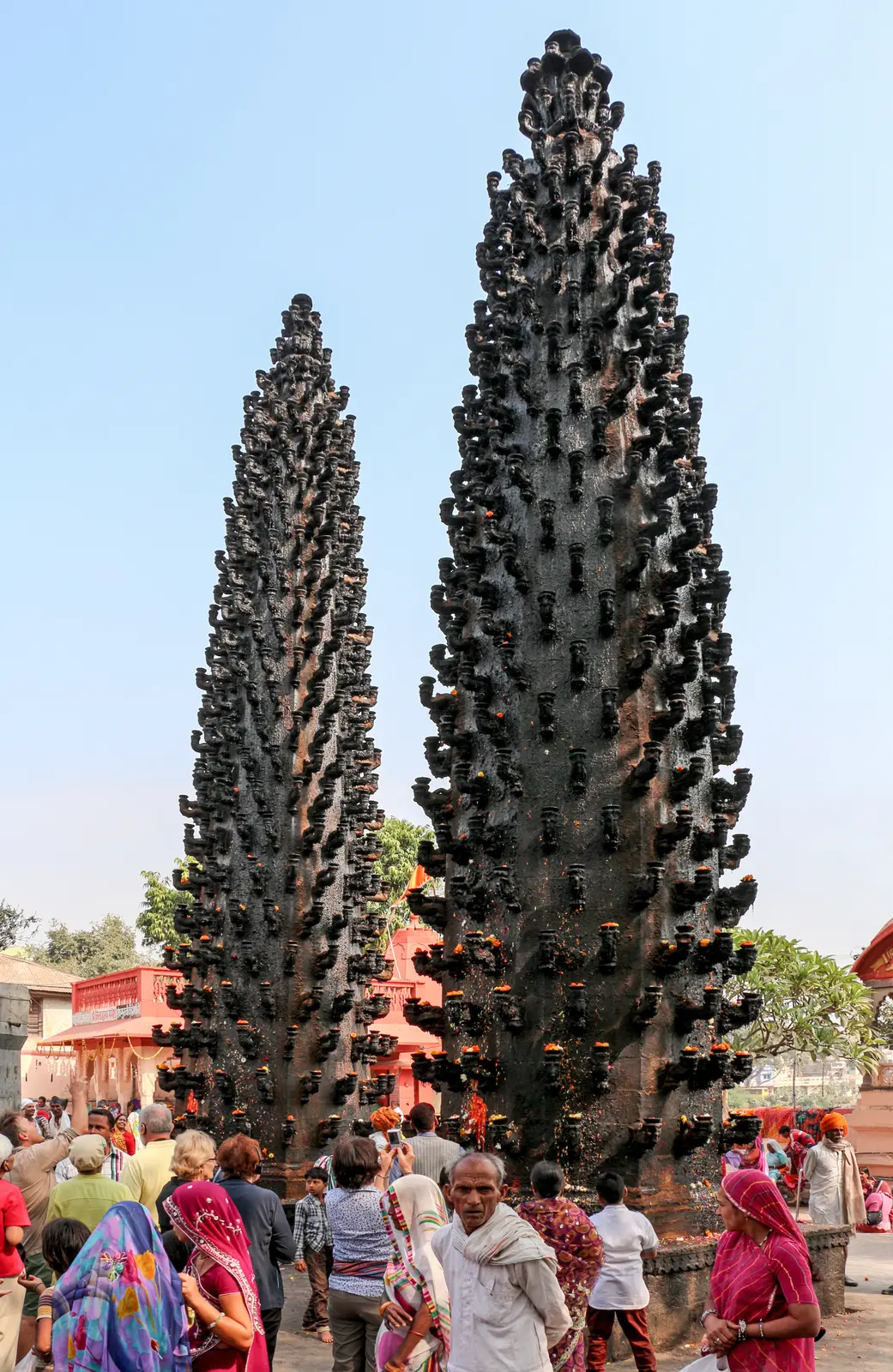
In front of the temple rise two conical lamp towers, blackened by generations of oil and smoke. They are regarded as a hallmark of Maratha temple art, although popular belief credits them to Vikramaditya. Local reports give their height as about 51 feet and the total number of lamp brackets as roughly 1,011; other sources quote different counts. Tradition calls the two towers Shiva and Parvati. Devotees whose wishes have been fulfilled sponsor the lighting, known as deepmalika, and bookings are often made months ahead. At dusk a small team climbs the towers, filling and lighting the lamps from the top down; news reports say about six men finish the task in a few minutes, using around 60 litres of oil and 4 kilograms of cotton wick. One family, the Joshis, is reported to have carried on this service for about a hundred years. In 2023 the district administration announced hydraulic ladders to make the climb safer.
Why devotees come
Harsiddhi is the principal goddess shrine of Ujjain, and most pilgrims who come for Mahakaleshwar also walk across to bow here. The belief is simple and strong: a sincere wish made before the Mother is granted, and when it is, the devotee returns to offer thanks, often by having the lamp towers lit. Worshippers bring red chunari, coconut, flowers and sindoor. The temple is especially crowded on the days sacred to the goddess and through both Navratris, when the towers are lit every evening and the courtyard fills long before the aarti begins. During the Simhastha Kumbh, held in Ujjain once every twelve years, the temple is one of the main stops for pilgrims. Beyond its legends, Harsiddhi offers something rare: an old, living ritual of fire and oil that is still performed by hand, evening after evening, in the middle of a busy city.
At a glance
- Presiding deity
- Goddess Harsiddhi, with Mahalakshmi, Mahasaraswati and Annapurna in the sanctum
- Tradition
- Shakta (goddess worship); revered as a Shaktipeeth where Sati's elbow is believed to have fallen
- Known for
- Two deep-stambh lamp towers, about 51 feet tall, lit at the evening aarti
- Era
- Founding credited by tradition to King Vikramaditya; the present structure dates from the Maratha period
- Sacred emblem
- A Sri Yantra, the symbol of Shakti, is enshrined in the temple
- Location
- Beside Rudra Sagar, about 500 m from Mahakaleshwar Temple, Ujjain
- Main festivals
- Sharadiya Navratri and Chaitra Navratri
- Entry
- Free for all devotees